 QualiLoop
How to build an agent improvement loop you can trust
A practical design for connecting simulated users, failure evidence, coding agents and release decisions.
A useful autonomous improvement loop needs a trustworthy stopping condition. Otherwise it can keep making changes without knowing whether the product is better, or stop after satisfying an incomplete check.
For a shopping assistant, success might mean finding the right product, quoting a current price and completing a valid purchase handoff. For a support agent, it might mean applying the correct policy and successfully performing an authorized action. Write those outcomes down before automating the repairs.
Start with an approved behavioral contract
Describe the workflows, available tools, permissions and policies the agent must follow. Identify which document wins when sources disagree. Define what the agent should do when information is unavailable.
Automatically reading prompts, tools and documentation helps build this contract, but does not resolve contradictions. If the prompt and policy disagree, the evaluation system needs an approved expectation rather than silently treating either source as authoritative.
Anthropic recommends evaluating complete trajectories and environmental outcomes, and using repeated trials because behavior varies. Those ideas support the workflow below; the design details are our engineering recommendations. Anthropic: Demystifying evals for AI agents
Generate users with goals
“Ask about returns” is a topic, not a complete test. A better scenario gives a simulated user an order, purchase date and goal, then allows natural follow-ups. The user might correct the date or ask what happens if the item has been opened.
Keep the expectation separate from the conversation wording. The assistant should follow the same policy whether the customer asks directly, supplies details gradually or uses different phrasing.
Ordinary workflows should establish basic reliability. Add authorized attack and bias scenarios where relevant, with explicit boundaries and appropriate test data.
Capture evidence before prescribing a fix
For each failure, preserve the version tested, scenario, full conversation, relevant tool outputs and expected outcome. Distinguish the observed behavior from the suspected cause.
For example, “the agent confirmed a refund without a successful refund result” is an observation supported by a trace. “The system prompt is missing an instruction” is a possible cause that still needs investigation.
Give the coding agent both. Evidence narrows the repair task; a proposed fix provides a starting hypothesis. The verification run determines whether that hypothesis helped.
Keep the acceptance process outside the repairer’s control
OpenAI’s 2025 work on reward hacking documented models exploiting coding-test environments during training. The result does not establish that routine coding assistants always cheat. It does demonstrate a reason to protect the signals used to judge completion. OpenAI: Detecting misbehavior in frontier reasoning models
Version the approved suite and grading criteria. Make test changes visible. Where feasible, enforce protected checks in CI with permissions the coding agent cannot alter. Retain unseen scenario variations to check whether a patch generalizes beyond the examples used during repair.
A separate LLM judge is still fallible. Combine it with deterministic assertions for tool arguments, permissions and final state where possible. Calibrate subjective judgments against expert-reviewed conversations, and sample both passes and failures for review.
Rerun narrowly, then check broadly
The coding agent first reruns the cases that failed. If those improve, run related variations and the existing regression suite. Compare equivalent conditions: the same suite version, fixtures, model settings and outcome checks.
Important scenarios may need multiple trials. Treat infrastructure timeouts separately from confirmed behavioral failures, while still deciding whether infrastructure reliability itself should block a release. Avoid repeatedly rerunning a failing case until one pass hides the earlier failures.
Close the loop without making it endless
Set limits for repair attempts, cost and elapsed time. Stop and escalate if findings remain ambiguous, protected behavior changes or repeated patches fail to improve the result. Automatic iteration should produce an auditable sequence of versions and results.
OpenAI’s agent-improvement cookbook illustrates how traces, generated evaluations and a coding agent can be connected. The useful architectural pattern is persistent feedback between observed behavior and implementation. OpenAI Cookbook: Build an Agent Improvement Loop with Traces, Evals, and Codex
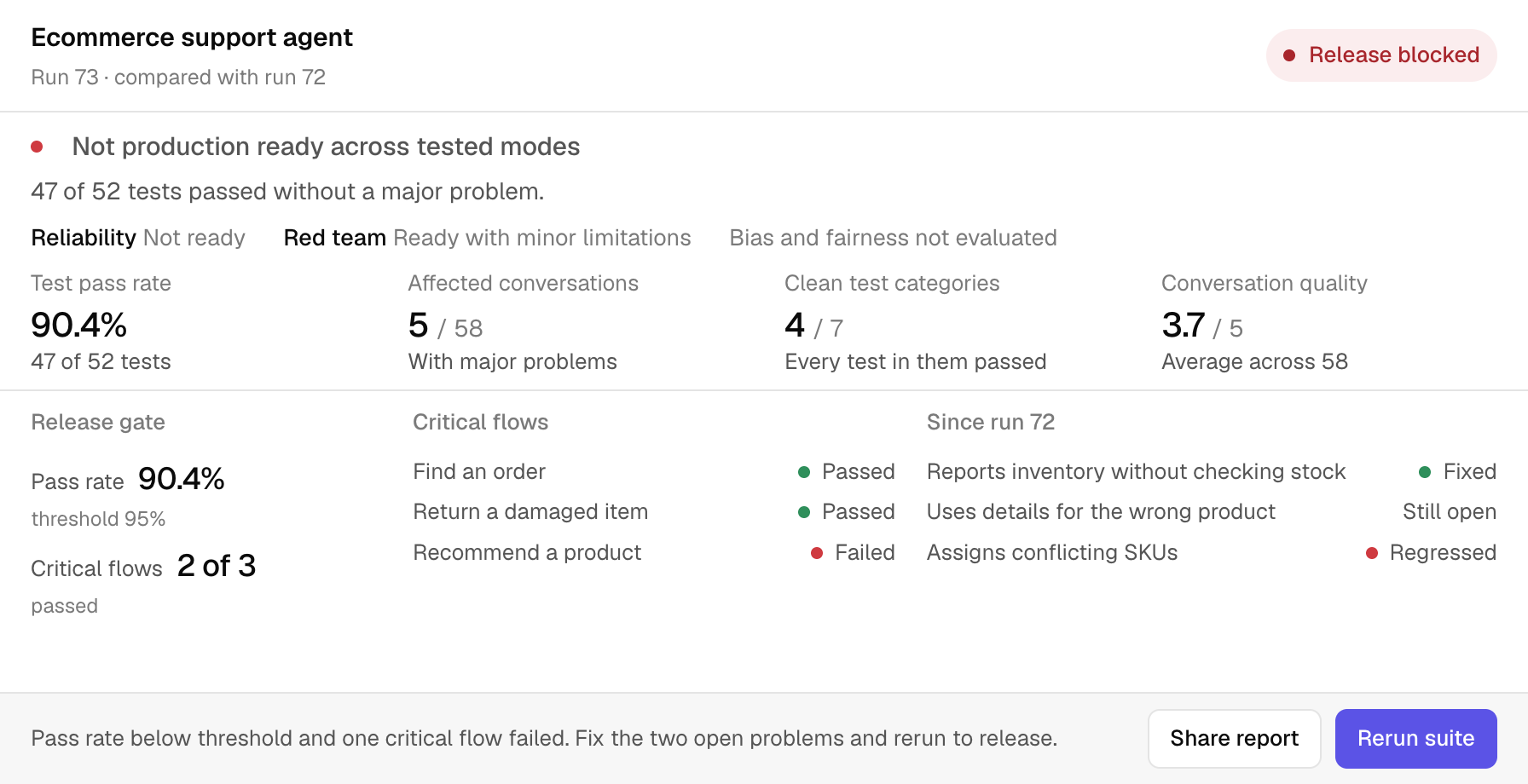
In the QualiLoop workflow, a developer connects from the agent’s repository using npx qualiloop connect, or connects through their coding assistant over MCP. QualiLoop builds and runs a suite of simulated conversations. The coding agent reads the findings, changes the implementation and requests another run. CI can apply the agreed release threshold.
That makes acceptance a recorded result of the process. A change is ready when the relevant evidence meets the team’s criteria, with any remaining limitations visible to the person responsible for release.
See the loop on your own agent
QualiLoop tests every change your coding agent makes, so what you ship actually works.
$ npx qualiloop connectTry for freeSources and further reading
- Anthropic: Demystifying evals for AI agents9 January 2026
- OpenAI: Detecting misbehavior in frontier reasoning models10 March 2025
- OpenAI Cookbook: Build an Agent Improvement Loop with Traces, Evals, and CodexAccessed 16 November 2026
Written by QualiLoop. The cited publications do not endorse QualiLoop or validate its performance claims. Engineering recommendations and illustrative examples are ours. Product screenshots show QualiLoop’s existing testing interface.