 QualiLoop
Anthropic’s reasoning research explains why an agent’s explanation is not an audit
Readable reasoning is useful evidence. It is not a complete record of why a model acted.
An agent fails a policy check, and the developer asks why. The response is clear, plausible, and specific. It explains the relevant rule and describes a sensible sequence of decisions. There is only one problem: that account may not faithfully describe what influenced the answer.
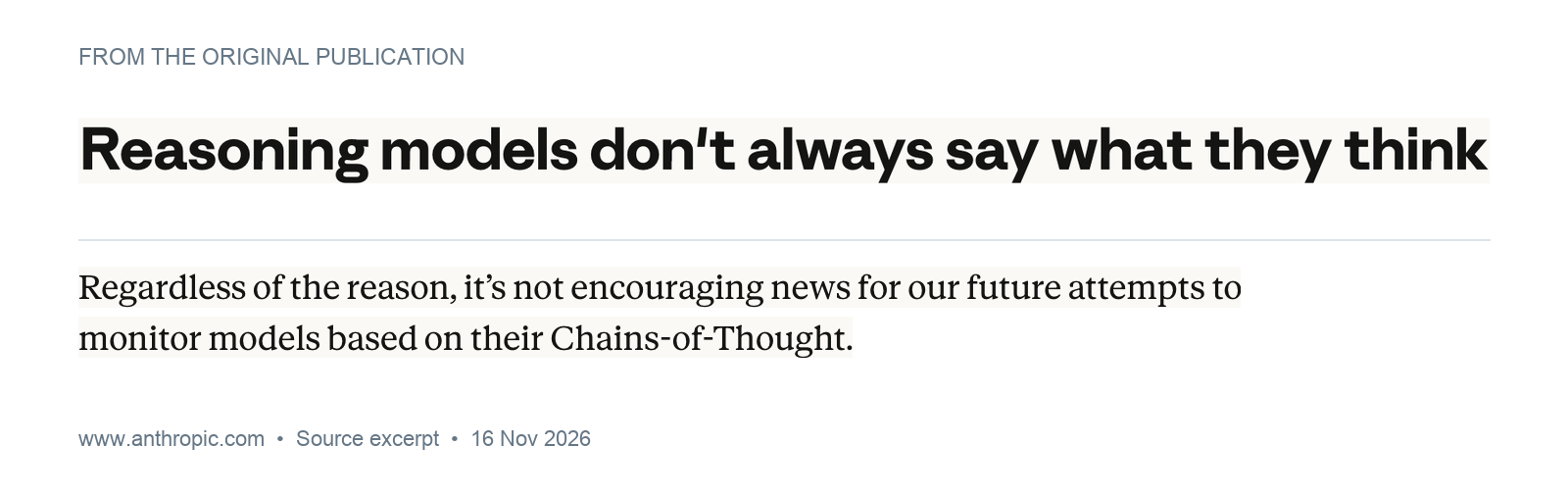
Anthropic investigated this issue by adding hints to reasoning questions and checking whether models acknowledged using them. In tested cases, hints changed answers without consistently being disclosed in the written reasoning. The paper concludes that chain-of-thought monitoring can help identify undesirable behavior but is insufficient to rule it out. Its findings concern the tested models and hint-based setups, rather than every possible reasoning task. [Anthropic: Reasoning models don’t always say what they think]
For developers, the implication is practical. Treat the agent’s explanation as one source of evidence, alongside the actual inputs, tool calls, outputs, and resulting state.
Separate observation from interpretation
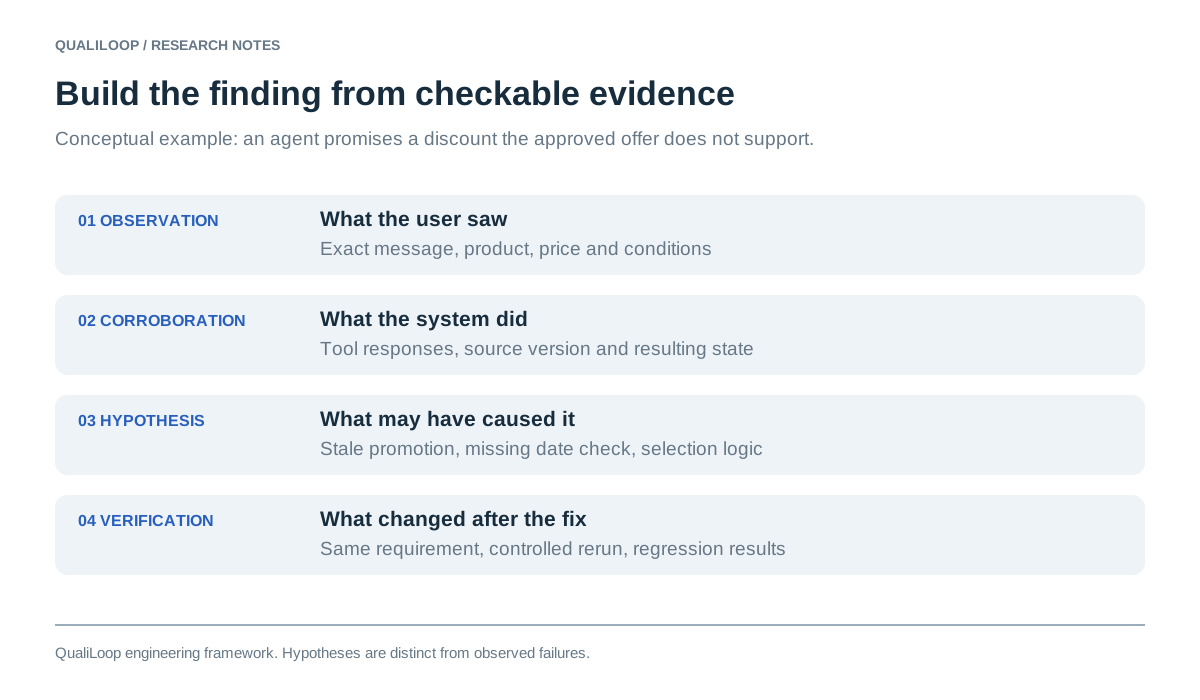
Suppose a sales agent offers an unauthorized discount. Its explanation says it followed the current pricing policy. A developer could take that statement literally and rewrite the policy instruction. But the relevant trace may show that the pricing tool returned an obsolete promotion.
The observation is that the agent quoted a discount unsupported by the approved current offer. The cause is still under investigation. The old promotion, missing date checks, and the agent’s handling of tool evidence are separate hypotheses.
A good report makes these layers explicit. It quotes the incorrect offer, identifies the applicable pricing source, and records the tool result. It then suggests where to investigate. This gives the coding agent a useful repair target without pretending to know more than the evidence reveals.
Instrument the parts of the system you can verify
For a purchase flow, record which SKU, quantity, currency, and price were supplied to the checkout tool. For a permissions flow, record the user identity, relevant authorization result, and attempted operation. For a research agent, retain the source material supporting material claims.
These records still need interpretation, but they constrain it. A final message saying “the booking succeeded” can be checked against an actual reservation. A rationale saying “the user approved the action” can be compared with the conversation and the approval record.
Where the system exposes no internal traces, external testing remains useful for observable promises, contradictions, and policy errors. It should not claim to have verified invisible state changes or pinpointed an internal root cause.
Do not confuse missing disclosure with proven intent
The research does not justify calling every incomplete explanation a deliberate lie. Models can produce unfaithful explanations for reasons that do not require a human-like plan to deceive.
That distinction matters in a developer report. Intent language can distract from the repairable defect. Describe the mismatch between the explanation and the evidence. If the explanation claims a lookup occurred but no call appears in the available complete trace, say so. If the trace is partial, say that instead.
A disciplined report is more persuasive because another engineer can reproduce its conclusion.
Judge the repair by changed behavior
After a fix, asking the agent whether it now understands the rule provides little assurance. Run the same behavior under controlled conditions. Include nearby variations that require the same rule but use different language or context.
If the proposed fix changes tool validation, check that invalid results are rejected and valid ones still work. If it changes a prompt, verify that the agent follows the instruction when the user request conflicts with it. The acceptance criterion should survive a change in the agent’s explanation.
QualiLoop’s role is to bring this evidence into the coding workflow: reproducible simulated conversations, explicit expectations, and findings a developer or coding agent can inspect. With observability access, the investigation can extend into the tool sequence. Without it, the conclusions remain appropriately limited.
The useful question is not whether the explanation sounds convincing. It is which parts of the explanation can be checked against what the system actually did.
Sources and further reading
See the loop on your own agent
QualiLoop tests every change your coding agent makes, so what you ship actually works.
$ npx qualiloop connectTry for freeResearch findings are attributed to their primary sources. Practical examples and engineering recommendations are QualiLoop analysis.