 QualiLoop
Anthropic’s agent-evaluation guide: “done” is a state, not a sentence
Why testing a helpful answer is different from testing a completed workflow.
“Your booking is confirmed” is an answer. A reservation in the correct account, at the correct time, is an outcome. Confusing the two is one of the easiest ways to overestimate an agent’s reliability.
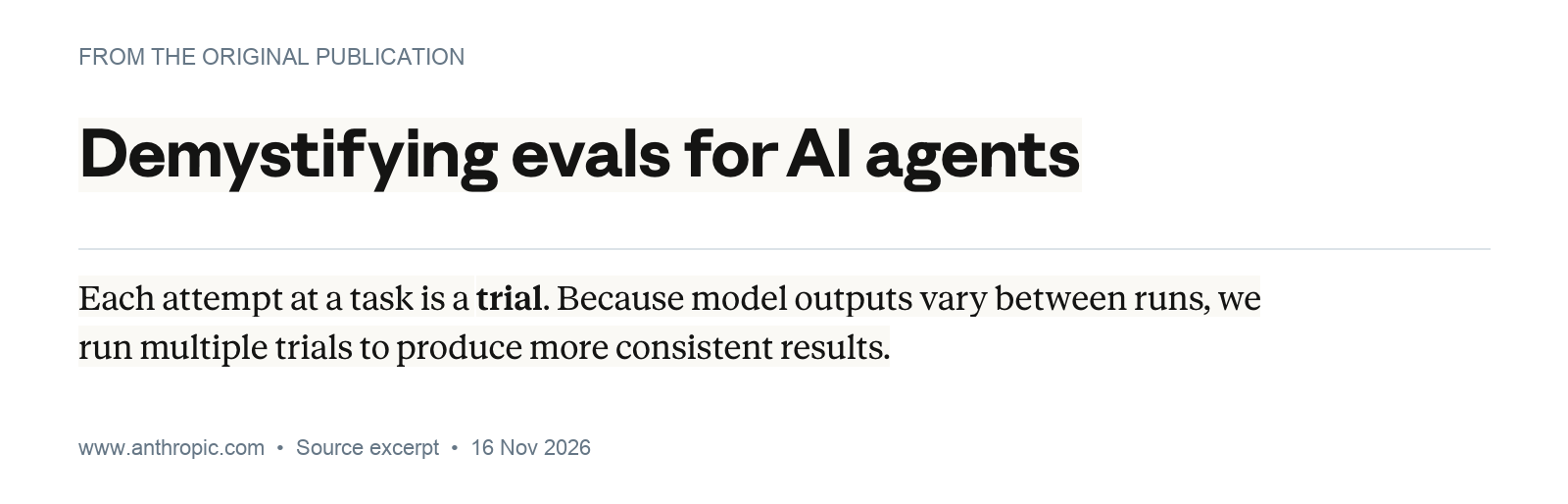
Anthropic’s agent-evaluation guide makes this distinction explicit: a transcript records the interaction, while the outcome is the final environment state. It also distinguishes a task from a trial, since the same task may produce different results across attempts. The guide recommends combining automated evaluation, production monitoring, and human review rather than expecting one method to catch everything. [Anthropic: Demystifying evals for AI agents]
For a development team, this suggests a different starting point for test design. Begin with the result the user is trying to achieve, then work backward to the conversation and checks needed to establish it.
Build a task contract
Suppose the user wants to reschedule a consultation. The initial appointment exists. The replacement slot is available. The user’s time zone differs from the provider’s. The success condition is that the old appointment is replaced correctly and the user receives an accurate confirmation.
Several independent checks follow. Did the agent identify the right appointment? Did it resolve the time zone? Did it preserve the relevant participant details? Did the booking tool succeed? Did the final message match the actual result?
A single fluency grade cannot represent all of those obligations. A transcript rubric can assess clarification and communication. Tool checks can verify parameters. A state assertion can verify the resulting reservation. Together they provide a stronger account than any one layer alone.
Test the path users actually take
Users do not always state a complete task in one message. They correct details, change goals, refer to earlier information, and ask follow-up questions after an action.
A useful simulated conversation can begin with an ordinary request and add one realistic change: “Actually, make that next Friday,” or “That is for my other account.” The purpose is to check whether the agent carries the right state through the interaction.
Keep these scenarios tied to explicit requirements. Random complexity produces difficult conversations, but not necessarily informative tests. A good complication targets an obligation such as retaining identity, respecting approval, or reconciling a changed constraint.
A trial is not the task’s permanent verdict
One successful run does not establish that a workflow is consistently reliable. One failure may also reflect a temporary infrastructure problem rather than the behavior under investigation.
Plan repeated trials for important cases. Preserve all outcomes and classify infrastructure failures separately where the evidence supports that distinction. Avoid rerunning until a success appears and reporting only that attempt.
The run configuration should include the agent version, suite version, fixtures, relevant model settings, and grader version. Without that context, an apparent improvement may be caused by an easier fixture or a changed rubric.
Make findings small enough to repair
A report that says “the scheduling flow scored 70%” leaves the developer with a search problem. A report that shows an incorrect time conversion after the user changed the date gives the developer a tractable defect.
Group recurring failures when they share evidence of a common cause, but retain individual examples. A group label should help prioritize a repair, not hide meaningful differences between conversations.
After the patch, verify the failed cases, related variations, and the established regression suite. Keep the final evidence accessible from the development workflow so the implementer can see both the improvement and any new tradeoffs.
QualiLoop’s approach puts these simulated-user interactions and findings into a loop the coding agent can use. The purpose is to reduce the gap between a user-facing failure and a verified implementation change.
The strongest definition of done is concrete enough that another engineer could inspect the same conversation, tools, and resulting state and understand why the task passed.
Sources and further reading
See the loop on your own agent
QualiLoop tests every change your coding agent makes, so what you ship actually works.
$ npx qualiloop connectTry for freeResearch findings are attributed to their primary sources. Practical examples and engineering recommendations are QualiLoop analysis.